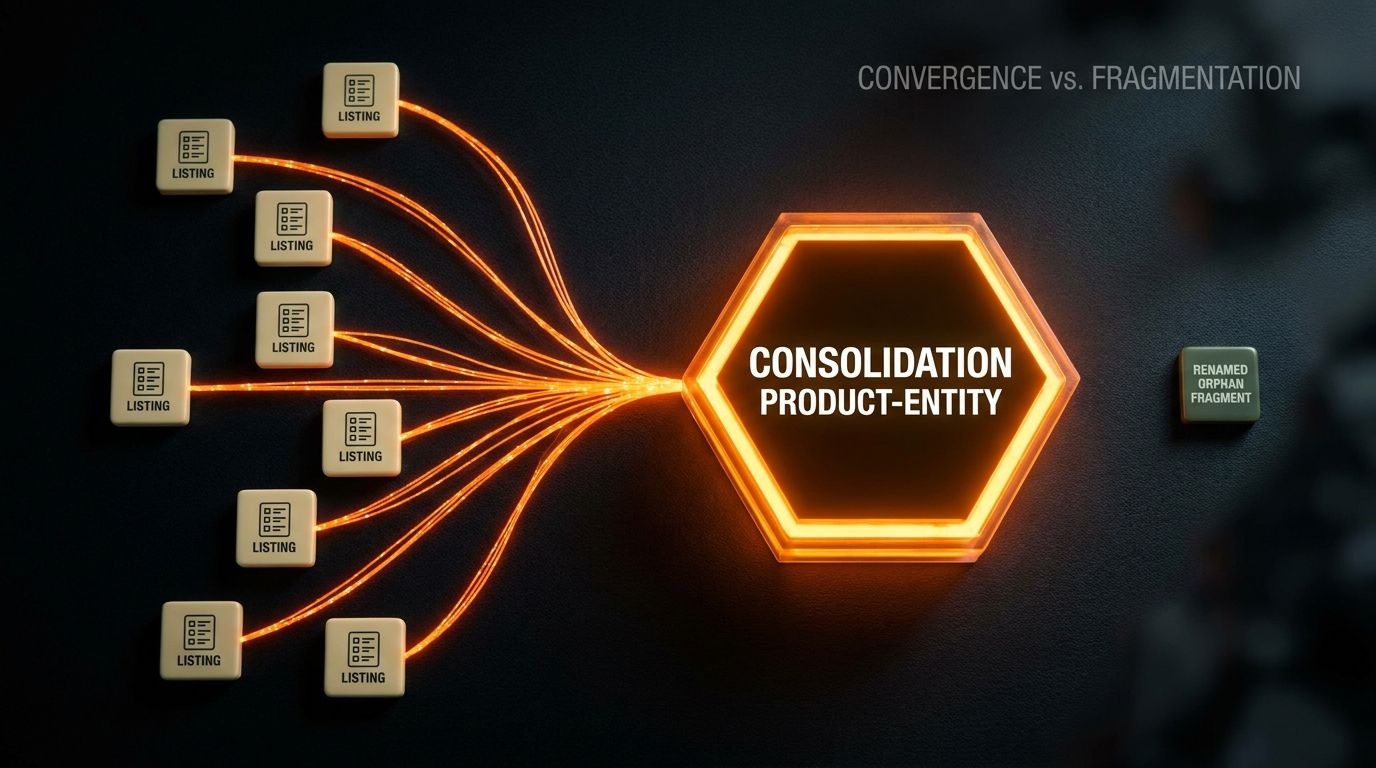
When the same product sells on twelve sites, AI engines face a canonicalization problem: which listing represents the product, and which seller gets the citation. Engines resolve it by consolidating listings that share identity signals (GTIN, brand, canonical name) into one product entity, then citing the listing with the strongest trust and data quality. The seller who wins is the one whose listing is the most identity-consistent, best-structured, and most corroborated, not necessarily the largest marketplace. The losing move is unique renaming per channel, which fragments your product across the engine's index and hands the consolidated citation to a competitor whose data lined up.
Distributed selling, your product on your own site plus Amazon, eBay, Google Shopping, niche marketplaces, is normal, and it creates a problem specific to generative engines. When a shopper asks an engine about the product or category, the engine has to reconcile many listings for what may be the same item, decide what the product actually is, and choose which source to trust and cite. How it resolves that determines whether you get the citation, a reseller gets it, or the product gets attributed to a marketplace with your listing buried inside it.
The core issue is listing canonicalization: the engine collapsing many listings into one product entity and picking a representative. Win canonicalization and the citations concentrate on you. Lose it and your presence on twelve sites becomes twelve fragments, none strong enough to be selected.
How engines consolidate listings
Engines group listings that share identity signals. The GTIN is the strongest: a global identifier that says "these listings are the same product," which is why cross-source identity verification is the foundation of marketplace AEO. Brand and canonical product name reinforce it. When listings agree on identity, the engine consolidates them into one product entity and reasons about that entity as a unit. When they disagree, because a seller renamed the product, omitted the GTIN, or restructured the specs, the engine cannot confirm they are the same item, and the listing falls out of the consolidated entity into its own weak fragment.
Which listing wins the citation
Once consolidated, the engine cites the representative listing, and it chooses on trust and data quality, not size. The listing that wins tends to have complete, accurate identity fields, structured specifications an engine can parse and compare, truthful current price and availability, and a trustworthy seller entity behind it. A smaller site with a cleaner, more complete, better-structured listing can win the citation over a larger marketplace listing that is thin or inconsistent, because the engine is selecting for citability, not traffic. This is the same selection logic as the product schema fields that determine visibility, applied across a distributed footprint.
The renaming trap
The most common self-inflicted marketplace failure is per-channel renaming for differentiation. A seller gives the product a unique name on each marketplace to stand out or avoid direct price comparison, and in doing so breaks the identity signals that let an engine consolidate the listings. Each renamed listing becomes an orphan the engine cannot confidently tie to the product entity, so instead of one strong consolidated presence, the seller has several weak fragments, and the citation goes to whichever competitor kept their identity clean. What feels like differentiation is fragmentation, and in the selection economy fragmentation is invisibility.
Your own site's role
Your own product page is the listing you fully control, and it should be the strongest node in the consolidated entity: complete identity fields, the richest structured specifications, truthful live data, and a strong seller entity behind it, the entity home that corroborates every marketplace listing pointing back to you. When your own page is the cleanest representative of the product, engines have a reason to cite you rather than the marketplace, which keeps the shopper relationship and the margin. This connects to the broader catalog legibility work: the same identity and structure discipline that makes a UCP feed legible makes a distributed product consolidate in your favor.
What to do
Keep identity fields identical across every channel, GTIN, brand, canonical name, no exceptions, because consistency is what consolidation runs on. Make your own product page the highest-quality listing in the set. Keep price and availability truthful everywhere, since an engine that catches one listing lying discounts the whole entity's trustworthiness. And monitor which source engines actually cite for your products, using citation-pattern tracking, so you can see whether you are winning canonicalization or handing it to a reseller.
Sellers spend real effort differentiating their listings across marketplaces, and for generative engines that effort is often actively harmful, because the thing that makes a listing distinct to a human, a unique name, a custom spec format, is exactly what stops an engine from recognizing it as the product. The winning distributed strategy is the opposite of differentiation: relentless identity consistency, so every listing reinforces one product entity, with your own page as its strongest representative. In marketplaces, sameness of identity is what earns the distinct citation.
Sources
- Google Merchant Center, product identifiers: how GTIN, brand, and MPN establish product identity across listings. support.google.com
- Schema.org, Product and Offer: the vocabulary for product identity and seller offers. schema.org/Product
- GS1, GTIN management standard: the authority on global product identifiers. gs1.org
- Website AI Score, GTIN, MPN, SKU cross-source verification: the identity layer consolidation depends on. View article
- Website AI Score, 14 product schema fields: the data quality that decides which listing wins. View article