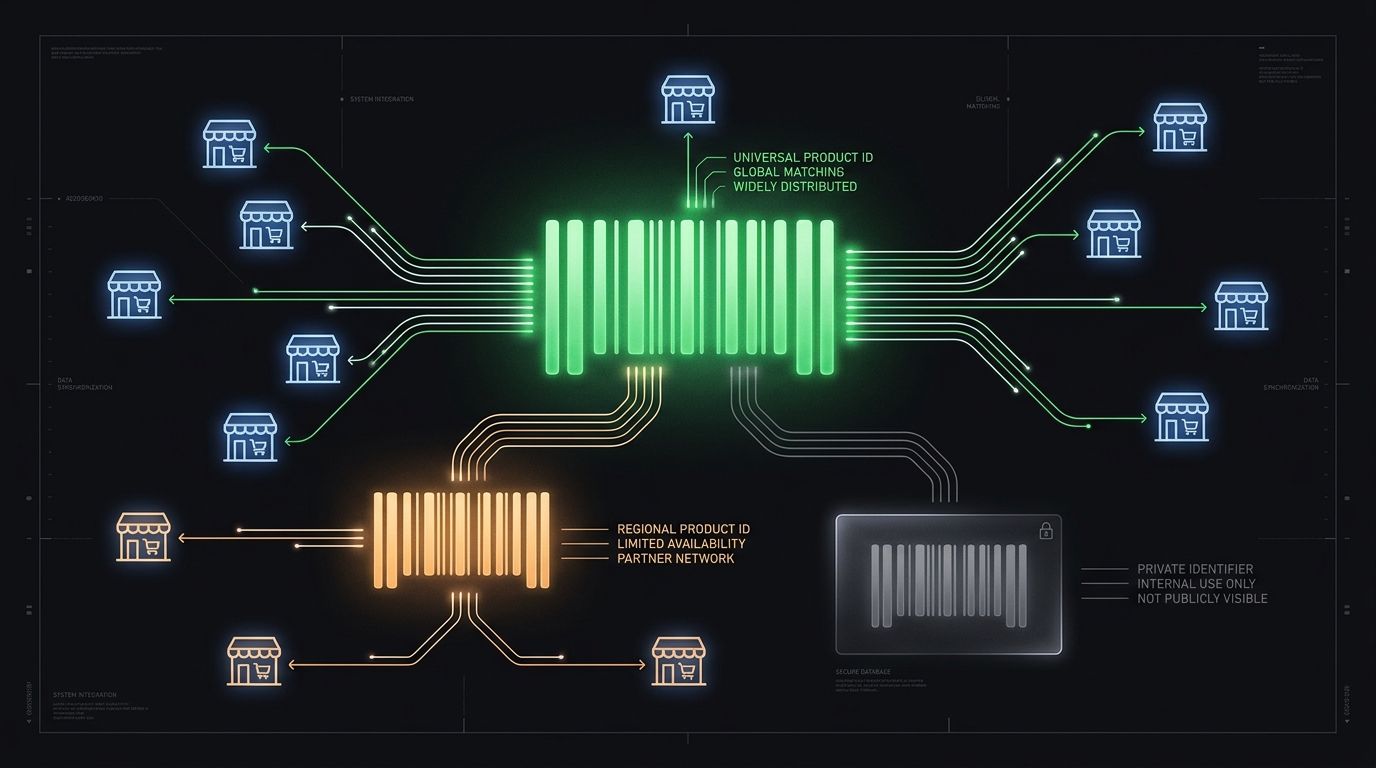
GTIN, MPN, and SKU look like three versions of the same thing and they are not. GTIN is the global identifier, the same number wherever the product is sold, and it is the one that lets an AI agent verify your listing is the identical physical product as a listing on another store. MPN is the manufacturer's part number, which identifies the product across sellers when no GTIN exists. SKU is your private internal code and is almost useless for cross-source verification. The GTIN is the cross-store verification signal. Without it, an agent cannot confirm your product is the one it is comparing, and uncertainty costs you the recommendation.
The reason these three identifiers get conflated is that on your own systems they often point at the same item, so they feel interchangeable. They are not interchangeable to an AI agent, because they answer different questions about identity. The question that matters for AI visibility is not "what do I call this internally" but "can an agent prove this is the same physical product being sold elsewhere," and only one of the three answers it well.
When an agent compares products across stores, its hardest problem is identity resolution: confirming that your "Acme Widget Pro 2000" and another store's "Acme WP-2000 Widget" are the literal same item, so it can compare them on price, availability, and shipping rather than treating them as different products. The identifier you provide determines whether the agent can make that match with confidence or has to guess.
GTIN: the only true cross-store identifier
The Global Trade Item Number is a registered, globally-unique number assigned to a product. A UPC, an EAN, an ISBN are all GTINs. The defining property is that it is the same number no matter who sells the product. When your listing and a competitor's listing both carry the same GTIN, an agent knows with certainty they are the identical physical item, and it can confidently compare them on every other dimension.
This certainty is the whole point. Identity resolution without a GTIN is probabilistic: the agent matches on name similarity, brand, and attributes, and assigns a confidence score. Identity resolution with a matching GTIN is deterministic: it is the same product, full stop. An agent that can deterministically match your product can compare it cleanly and recommend it with confidence. An agent that has to guess may exclude you rather than risk a wrong match, because recommending the wrong product to a user is a worse outcome for the agent than omitting an uncertain one. The GTIN converts your listing from "probably this product" to "verified this product," and that conversion is often the difference between making and missing the shortlist.
MPN: the fallback when no GTIN exists
The Manufacturer Part Number identifies a product as the manufacturer designates it. It is shared across sellers of that manufacturer's product, so it provides cross-seller identity, but it is weaker than a GTIN because there is no single global registry enforcing uniqueness across all manufacturers. Two different manufacturers could in principle use overlapping part-number schemes, so an agent treats MPN as strong corroboration rather than absolute proof.
MPN matters most for products that genuinely have no GTIN: custom items, certain industrial parts, products from manufacturers who never registered barcodes. For these, the MPN paired with the brand is the best identity signal available, and providing it lets an agent match across the sellers who carry that manufacturer's line. The rule is simple: provide GTIN when the product has one, provide MPN when it does not, and provide both when you have both, because together they give the agent maximum confidence.
SKU: useful to you, nearly useless to an agent
The Stock Keeping Unit is your own internal code for tracking inventory. It is meaningful only inside your systems. Your SKU for a product has no relationship to anyone else's SKU for the same product, so it provides zero cross-store verification value. An agent reading your SKU learns nothing it can use to match your product against another store's listing.
This does not mean omit it. The SKU still belongs in your schema because it is useful for other purposes, including the agent referencing the specific item back to you during a transaction. But understand its scope: it is an internal pointer, not an identity proof. The common mistake is treating SKU as sufficient product identification because it feels like an ID. To an agent doing cross-store comparison, a SKU without a GTIN or MPN is a product it cannot verify, which is functionally a product it cannot confidently recommend.
Why verification decides the recommendation
The throughline is that AI shopping increasingly runs on comparison, and comparison runs on verified identity. An agent asked to find the best price on a specific product has to first confirm which listings are that product. The listings it can verify enter the comparison; the listings it cannot verify get a confidence penalty or get dropped. Your identifier strategy directly controls which side of that line you land on.
The contrarian point is that GTIN is not a nice-to-have data-quality field, it is a visibility field. Catalogs treat barcodes as an inventory detail and leave the GTIN out of their schema, not realizing that the missing GTIN is what is making their products lose cross-store comparisons to identical products that included it. If you sell products that exist on other stores, the GTIN is among your highest-impact schema additions, because it converts every comparison from a guess into a proof. This connects directly to how the identity fields nest inside the product schema graph, and it is one of the fourteen fields that determine whether an agent treats your ecommerce listing as buyable. Provide the GTIN, fall back to MPN, keep the SKU for your own use, and let the agent verify rather than guess.
Sources
- GS1, GTIN standard: the authority on global trade item numbering. gs1.org
- Schema.org, product identifier properties: the definitions for gtin, mpn, and sku. schema.org/gtin
- Google, product identifiers in structured data: how identifiers are used for product matching. developers.google.com
- Website AI Score, JSON-LD product nesting: placing identity fields in the product graph. View article
- Website AI Score, ecommerce pricing and stock for AI: the buyability fields that pair with identity. View article