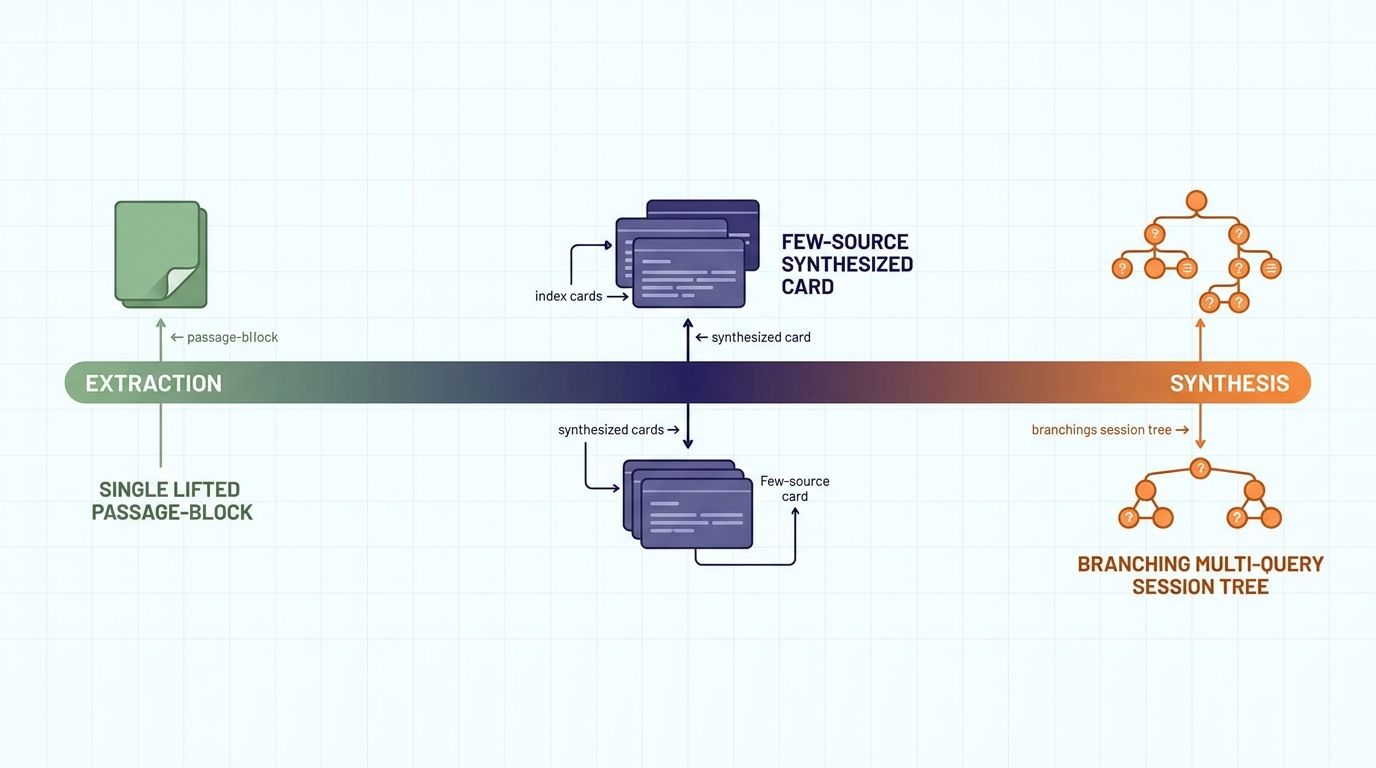
Featured snippets, AI Overviews, and AI Mode are three different surfaces on a spectrum from extraction to synthesis. A featured snippet lifts one passage from one page, so it rewards a single clean, direct answer. AI Overviews synthesize a short answer from several sources, so they reward being one of a few citable pages on a topic. AI Mode runs a full conversational, multi-query session, so it rewards deep, well-structured content that satisfies follow-ups. The same page can win or lose each depending on its structure. Optimizing for one is not optimizing for all: extraction wants a quotable block, synthesis wants comprehensive citability.
These three get lumped together as "AI search," which hides the fact that they work differently and reward different content. Understanding the spectrum, from lifting a passage to synthesizing an answer to conducting a session, tells you why a page wins one surface and loses another, and what to change. The organizing idea is a single axis: how much the surface extracts versus synthesizes.
Featured snippets: pure extraction
A featured snippet is the oldest of the three and the simplest: the engine lifts one passage from one ranking page and displays it as the answer. It rewards a single, clean, directly-stated answer to a specific question, formatted so it can be lifted whole, a concise paragraph, a clear list, a definition. The winning move is to state the answer plainly and completely in one extractable block near where the question is posed, which is the classic answer-in-the-first-hundred-tokens discipline. A snippet is won at the passage level: one page, one block, lifted verbatim.
AI Overviews: light synthesis
AI Overviews sit in the middle. Instead of lifting one passage, the engine synthesizes a short answer from several sources and cites them. This changes the target: you are no longer trying to be the single liftable passage, you are trying to be one of the few sources the engine draws from and credits. That rewards being genuinely citable on the topic, direct answers, yes, but also the information gain that makes you worth including over a redundant source, and the entity strength that makes the engine trust you. A page can win the featured snippet and still be left out of the Overview if it is thin beyond its one good passage, because synthesis samples breadth, not just the single best block.
AI Mode: full synthesis over a session
AI Mode is the deep end: a conversational experience that runs multiple queries behind a single question and reasons across the results over a session. It rewards depth and structure that satisfies not one question but a chain of them, because the engine fans a query out into many sub-queries and assembles across them. Content that wins here answers the obvious question and the follow-ups, is structured so each section stands alone as a citable unit, and holds together as a comprehensive resource. A thin page with one good answer wins a snippet and is invisible in AI Mode, because the session samples far more than one passage.
Why one page wins some and loses others
The spectrum explains the common confusion of a page that shows up in one surface and not another. A page with a single excellent answer block but little depth wins featured snippets and thin AI Overviews and loses AI Mode. A deep, well-structured resource whose answer is buried under preamble loses the snippet but wins AI Mode. The page that wins all three has both properties: a clean extractable answer up top and genuine depth beneath it, each section independently citable. That combination is the target, and it is why how your content chunks matters across every surface.
A worked example makes the spectrum concrete. Take the query "best CRM for a five-person sales team." The featured snippet goes to a page with one tight paragraph naming a pick and the reason, liftable whole. The AI Overview draws on three or four sources that each add something, one contributes pricing reality, another the small-team fit criteria, a third an honest limitation, and a page that merely repeats the consensus list gets skipped for adding nothing. In AI Mode, the user follows up with "which of those handles email sequences" and "what does migration from spreadsheets look like," and the citation flows to the resource whose sections answer those follow-ups standalone. Same query, three surfaces, three different winning shapes.
How to optimize across the spectrum
Lead every important page with a clean, directly-stated answer (wins extraction). Build genuine depth and information gain beneath it (wins synthesis). Structure so each section is a self-contained, citable unit (wins across all three, since every surface samples at the passage or section level). And keep the entity strong, because synthesis surfaces weigh trust more heavily than pure extraction does. One well-built page can win all three surfaces; the failure is optimizing for only the surface you currently see and neglecting the others.
Teams chase whichever surface is getting attention this quarter, restructuring for AI Overviews, then for AI Mode, as if they were separate optimization targets. They are not. They are points on one axis, and the page built correctly for the whole spectrum, extractable answer plus real depth plus clean structure, wins all of them without per-surface chasing. The wasted effort is re-optimizing for each surface in turn; the durable move is building the page that satisfies extraction and synthesis at once, because that page holds up under whichever surface the engines emphasize next.
Sources
- Google, AI features and your website: Google's guidance spanning AI Overviews and AI Mode. developers.google.com
- Google Search Central, featured snippets: how the extraction surface selects and displays a passage. developers.google.com
- Website AI Score, query fan-out: the multi-query mechanism behind AI Mode. View article
- Website AI Score, the inverse pyramid: the answer-first structure that wins extraction. View article
- Website AI Score, information gain: the property that wins synthesis surfaces. View article