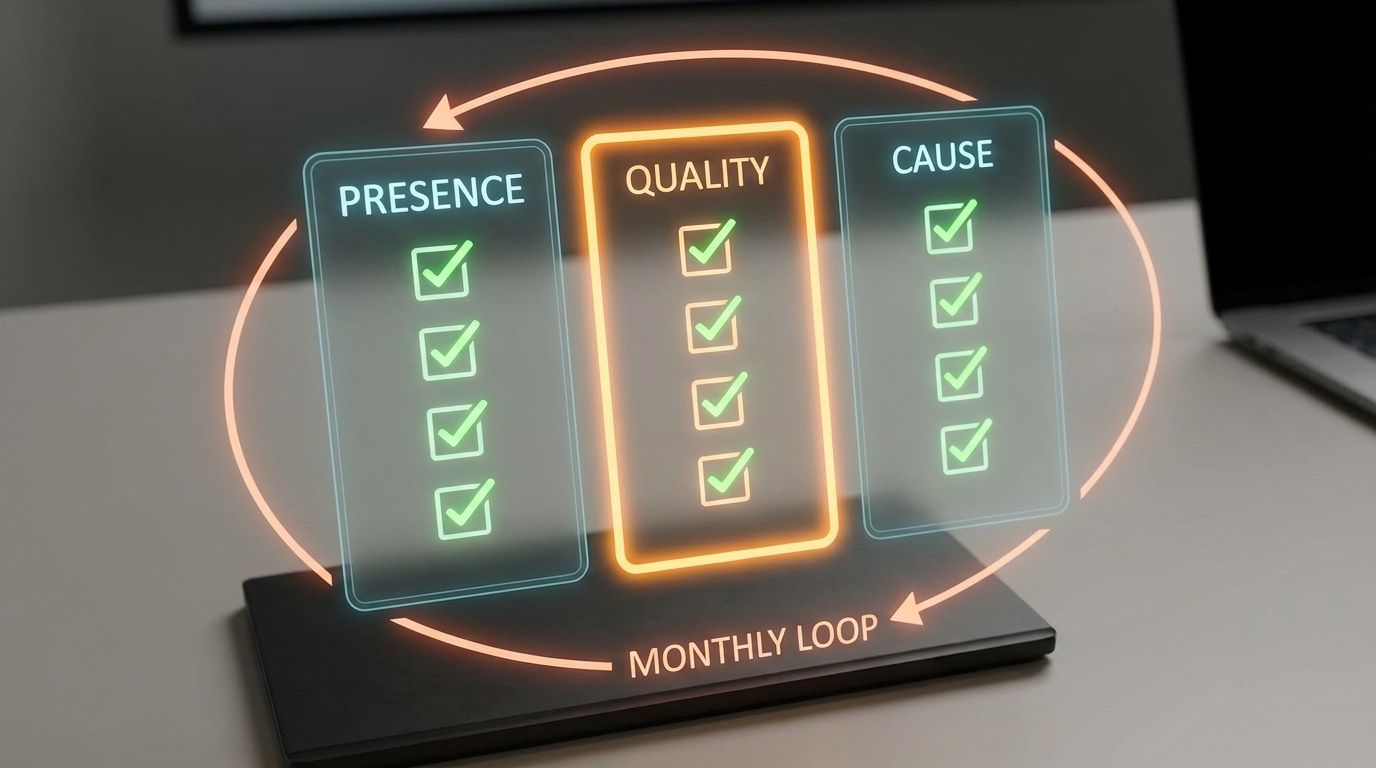
A monthly citation audit is a fixed routine that catches AEO drift before it costs you. Run twelve checks in three groups: presence (are you still cited for your core queries, how often, on which engines), quality (are you described accurately, is your entity intact, are competitors displacing you), and cause (did anything change on your site, in your schema, or in your rendering). The point of doing it monthly and identically is that AEO standing decays and shifts without warning, and only a repeated, consistent baseline lets you see a change as a change rather than as noise. Same checks, same queries, same order, every month.
AI citations are not set-and-forget. A page cited this month can quietly stop being cited next month, because an engine updated, a competitor improved, your rendering broke, or the citation was volatile to begin with. Without a routine, you notice only when traffic or leads drop, long after the cause. A monthly audit turns that reactive scramble into a standing early-warning system, and the discipline that makes it work is consistency: the same twelve checks, run the same way, so month-over-month differences are real signal.
The twelve checks fall into three groups, presence, quality, and cause, and you run them in that order because each group tells you something the next depends on.
Group one: presence (checks 1 to 4)
Presence establishes whether you are still in the answer. Check 1: query your core set (the handful of questions you most want to be cited for) across the engines that matter, and record whether you appear. Check 2: record how often, since a single result is noise and only frequency across repeated queries is signal. Check 3: record which engines cite you, because a page strong on one engine can be absent on another and the mix shifts over time. Check 4: compare against last month's baseline to classify each query as stable, improved, or declining. This group answers "am I still being selected," and a decline here is the trigger for the rest of the audit.
Group two: quality (checks 5 to 8)
Presence without quality is a trap: you can be cited and described wrong. Check 5: read how engines describe you, tracking the sentiment and accuracy of your brand description, since a drift toward negative or generic language is an early warning. Check 6: verify your entity is intact, that engines identify you correctly and have not begun confusing you with a similar brand, a sign of the entity confusion covered in adversarial AEO. Check 7: check whether competitors are appearing alongside or displacing you in your core answers, which reveals co-mention shifts before they harden. Check 8: verify the facts engines state about you are current, since stale facts are both a citation risk and a correction opportunity.
Group three: cause (checks 9 to 12)
When presence or quality declines, cause tells you why. Check 9: review what changed on your site since last audit, a redesign, a migration, a template change, since site changes are the most common self-inflicted cause of citation loss. Check 10: revalidate your schema, because a deploy can silently break structured data that was moving your citations. Check 11: reconfirm rendering, that your content still arrives as readable HTML and has not regressed into an empty client-side shell, which is a silent catastrophic failure a single framework update can cause. Check 12: log everything and assign actions, so the audit produces a decision, not just a report.
Why the routine has to be identical
The value is entirely in the repetition. If you change the queries, the engines, or the method each month, you cannot tell a real decline from a measurement artifact. A fixed routine creates a comparable baseline, so when check 2 shows your citation frequency halved, you know it halved rather than wondering if you just queried differently. Treat the audit like a recurring instrument reading: same instrument, same conditions, and the trend line means something. This is the operational version of reading share of model over time.
How long it takes and when to run it
The full twelve checks take under two hours once the routine is set, most of which is querying and recording. Run it on a fixed date each month so it actually happens, monthly cadence is chosen deliberately: frequent enough to catch drift while it is small, infrequent enough that the noise between readings averages out. Weekly is too noisy given citation volatility; quarterly is too slow to catch a rendering regression before it costs a quarter of visibility.
Most teams audit their AEO only when something breaks, which means they are always diagnosing a loss they already suffered, and they mistake the routine as overhead. But the sites that hold their citations are not the ones that optimize hardest once, they are the ones that notice drift first, because in a system this volatile the durable advantage is not a better one-time result, it is a shorter time-to-detection. The monthly audit is cheap insurance against silently going invisible, and the teams that skip it are the ones who find out too late that they already have.
Sources
- Google, AI features and your website: the technical factors an audit's cause checks should reflect. developers.google.com
- Schema.org, full documentation: the structured-data spec to validate against in check 10. schema.org
- Website AI Score, five citation patterns: the framework for classifying each query's trend. View article
- Website AI Score, sentiment quotient: the quality check on how engines describe you. View article
- Website AI Score, empty-shell rendering audit: the regression check 11 exists to catch. View article