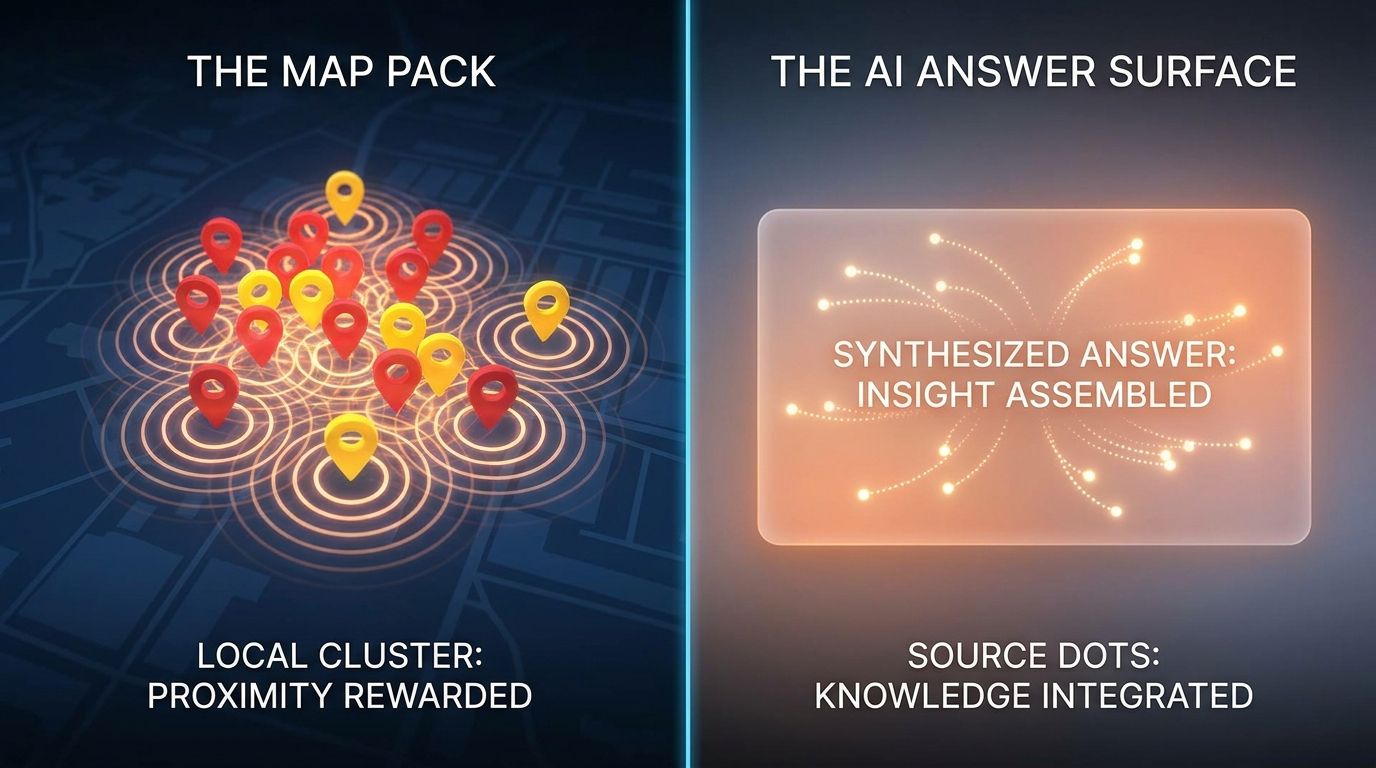
Local AI visibility runs on two different surfaces that reward different things. The map pack is driven by proximity, your Business Profile, and review signals. AI Overviews and AI answers for local queries behave more like general AEO: they synthesize a recommendation from web content, reviews, and structured data, and they can cite a business the map pack would rank lower. Optimizing for one does not automatically win the other. A local business needs both a strong Business Profile for the map surface and citable web content plus a consistent entity for the answer surface. Treating local AI as just Business Profile work is the common, costly mistake.
Local search used to be one contest: rank in the map pack for "plumber near me." Now a local query can return a map pack, a set of organic links, and a generated AI answer that names and describes specific businesses, and those outputs draw on overlapping but distinct signals. Understanding the split is the whole game, because the tactics that win the map pack are necessary but not sufficient for the answer surface, and the reverse is also true.
Call the split what it is: the two-surface local problem. Most local businesses optimize one surface (usually the Business Profile) and assume it covers the other. It does not, and the gap is where competitors who understand both quietly take the citations.
What drives the map pack
The map surface is proximity-weighted and profile-driven. The dominant signals are your Business Profile completeness and accuracy, category selection, proximity to the searcher, review quantity and quality, and consistency of your name, address, and phone across the web. This is well-trodden local SEO, and it still matters because the map pack is not going away. The key property is that proximity heavily gates it: a searcher's location strongly determines which businesses are eligible, which is why the map pack is a local contest in the literal sense.
What drives the local answer surface
AI Overviews and generated local answers behave differently. They assemble a response from web content, review sentiment across sources, and structured data, and they are less strictly proximity-gated, so a business with strong citable content and a clear entity can be named in an answer even where it would not top the map pack. This surface rewards the general AEO signals: content that answers the local question directly, a consistent and verifiable entity, and corroboration across sources. It is closer to standard answer-engine optimization than to classic local SEO, which is exactly why Business-Profile-only strategies underperform on it.
The overlap: what serves both
Two things pay on both surfaces, so start there. Review signals feed the map pack directly and shape how AI answers describe you, since engines read sentiment across review sources when they characterize a local business. And NAP-plus-entity consistency, your name, address, phone, and identity agreeing everywhere, strengthens map ranking and gives the answer surface a verifiable entity to cite. That consistency is the local version of anchoring an entity with sameAs: the same discipline, applied to a business with a physical location.
What only serves the answer surface
The content layer is where map-optimized businesses have nothing and lose citations. AI answers to local questions ("best family dentist in [city] for anxious kids," "which [city] roofer handles flat roofs") pull from content that addresses the specific question, not from a Business Profile. A business with pages that answer real local questions directly, in the answer-first structure engines extract cleanly, can be named in answers its map ranking would not earn. And the content has to be readable to engines at all, which is where JavaScript-rendered local sites silently fail, arriving as empty shells no engine can cite.
How to work both surfaces
Keep the Business Profile complete, accurate, categorized correctly, and reviewed, that is the map-pack floor. Then build the answer layer the map-only competitors skip: content answering the specific local questions your customers ask, a consistent verifiable entity across your site and the local ecosystem, and structured data declaring who and where you are. Measure both, because they move independently, track your map ranking and, separately, whether AI answers name you and how they describe you, using the same citation-pattern reading as any other AEO program. A quick visibility audit tells you which surface you are currently winning.
The local businesses most confident in their visibility are often the ones with a great Business Profile and nothing else, which means they own the map pack and are invisible on the answer surface that increasingly sits above it. The next wave of local competition is not for map position, it is for the sentence a generative engine writes when someone asks it to recommend a business, and that sentence is written from content and entity signals a Business Profile alone never provides. Winning local now means winning twice, on two surfaces that most of your competitors still think are one.
Sources
- Google Business Profile Help: the official guidance on the profile signals behind local ranking. support.google.com
- Google, AI features and your website: how generated answers, including local ones, source and cite content. developers.google.com
- Schema.org, LocalBusiness: the structured-data type for local entity and location. schema.org/LocalBusiness
- Website AI Score, what is AEO: why the answer surface follows answer-engine rules, not local-SEO rules. View article
- Website AI Score, empty-shell rendering audit: the failure that makes local content invisible to engines. View article