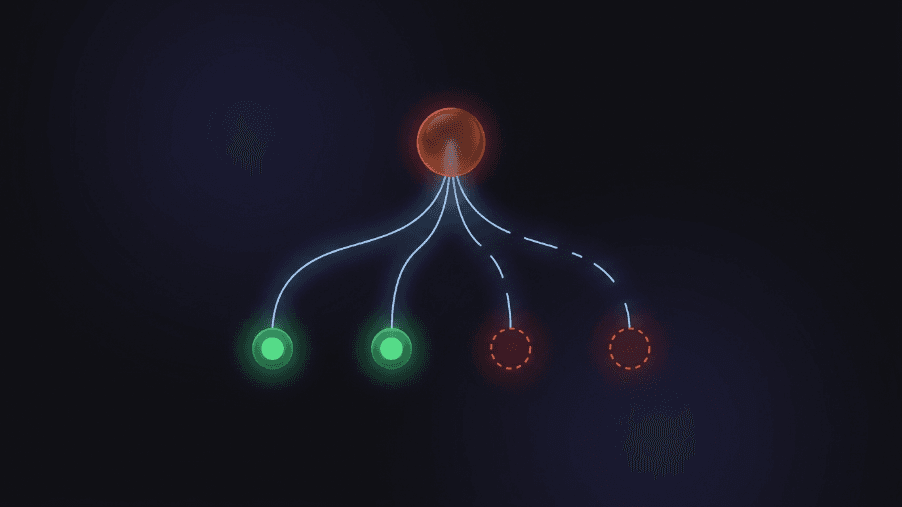
An AI content gap is a relevant part of a target query that a page does not answer clearly enough to serve as a complete source, and it is the most common reason a readable, well-written page still never gets cited. Engines fan a query into sub-questions and select the source that covers them; a page that answers only the headline loses the citation to one that also covers the comparison, the cost, and the limitation. Content gap diagnosis finds those missing angles for one page against one phrase. In the Content Creator's Diagnose mode it costs one credit, takes seconds, and returns each gap with a priority, the intent it serves, and a summary of why the page loses it. Ten free credits on signup means ten pages diagnosed before you spend anything.
Content gap analysis in SEO meant finding keywords competitors ranked for and you did not. For AI citation the unit is different and finer: not a keyword, but a sub-question. When someone asks an engine "best running shoes for marathons," the engine does not look for a page containing those words; it works out what the asker needs, the comparison between shoe types, the durability question, the price framing, and selects the source that covers the most of it well. A page missing any of those angles has a gap, and gaps are where citations leak.
A page is cited to the degree it answers the full set of questions the phrase implies, and diagnosis is the act of listing which ones it currently does not. Sub-question coverage is the whole game.
What is an AI content gap, precisely?
A missing sub-question. Engines run query fan-out: one user question becomes several internal retrievals, each for a facet of the need. Your page competes on each facet separately. A gap is a facet where your page has no answer, or a weak one, and the citation for that facet goes elsewhere. Gaps are not about length; a 3,000 word article can miss the one comparison the buyer actually cares about, and a 900 word article that covers it wins. That is why diagnosis has to be run against a specific phrase: the set of sub-questions is defined by the query, not by the topic. Gaps come in three kinds, and they need different fixes: information that is missing, information that is present but expressed too weakly to lift, and information that exists but is technically inaccessible to the crawler.
How does Diagnose mode find the gaps?
You give it a page URL and a target phrase. It reads the page as an engine would, models what the phrase demands, and compares the two, returning the gaps as a ranked list. Each gap carries a title (the missing angle, phrased so you could write to it), a priority (high, medium, low, by how much citation the gap costs), the intent it serves (informational, commercial, comparative), an estimated length to close it, and a one-line summary of why the page loses on it. It also drafts a preview heading and paragraph for the top gap, so you can see what closing it looks like before you commit. One credit, roughly the time it takes to read this sentence.
Which pages should you diagnose first?
Three kinds, in order of return. Pages that already rank in classic search but are not cited by AI, because they are readable and authoritative and losing only on coverage, the cheapest gap to close. Pages that were cited and are decaying, because the gap is usually a newer sub-question the page never addressed. And a top competitor's page for your phrase, because diagnosing what they are missing tells you the gap you can own outright. Ten free credits covers all three several times over, and the competitor diagnosis in particular is a use most teams never think of. For the scoring logic behind each gap, see how a content AI score is measured.
What do you do with the gap list?
Close the high-priority gaps first, and close them in the same workspace. Blog from Gap takes a gap title and writes the full article that answers it, for four credits, so a high-priority gap becomes a new citable page. Rewrite restructures the existing page to fold in missing angles while preserving its facts. On-Page Section produces a commercial section for a gap on a product or landing page. Then diagnose again for one credit to confirm the gap is closed. The loop is diagnose, close, confirm, and its unit of work is the sub-question, which is the unit the engines actually select on.
Why diagnose before writing at all?
Because writing without a diagnosis is guessing at coverage, and the guess is usually wrong in the same way: the writer answers the headline question thoroughly and the buyer's real sub-questions thinly. One credit before drafting tells you exactly which angles the phrase demands, which turns a 1,500 word article from an essay on a topic into a coverage plan for a query. Run the free scan first to confirm the page is readable, register for the free credits, and make diagnosis the first step of every piece rather than the post-mortem after it fails.
The expensive way to discover a gap is to publish, wait, notice the page is not cited, and commission a rewrite on instinct. The gap was knowable for one credit before the first draft existed. The teams that get cited consistently are not the ones with the best writers, they are the ones who found out what the query demanded before they wrote a word, and then wrote exactly that.
Sources
- Google, AI features and your website: how generative answers are assembled from multiple sources. developers.google.com
- Princeton, GEO: Generative Engine Optimization: research on what content generative engines select. arxiv.org/abs/2311.09735
- Website AI Score, Content Creator: Diagnose mode, one credit per page. websiteaiscore.com/content-creator
- Website AI Score, query fan-out: the mechanism that turns one question into several facets. View article
- Website AI Score, AI citation decay: why decaying pages are a diagnosis priority. View article