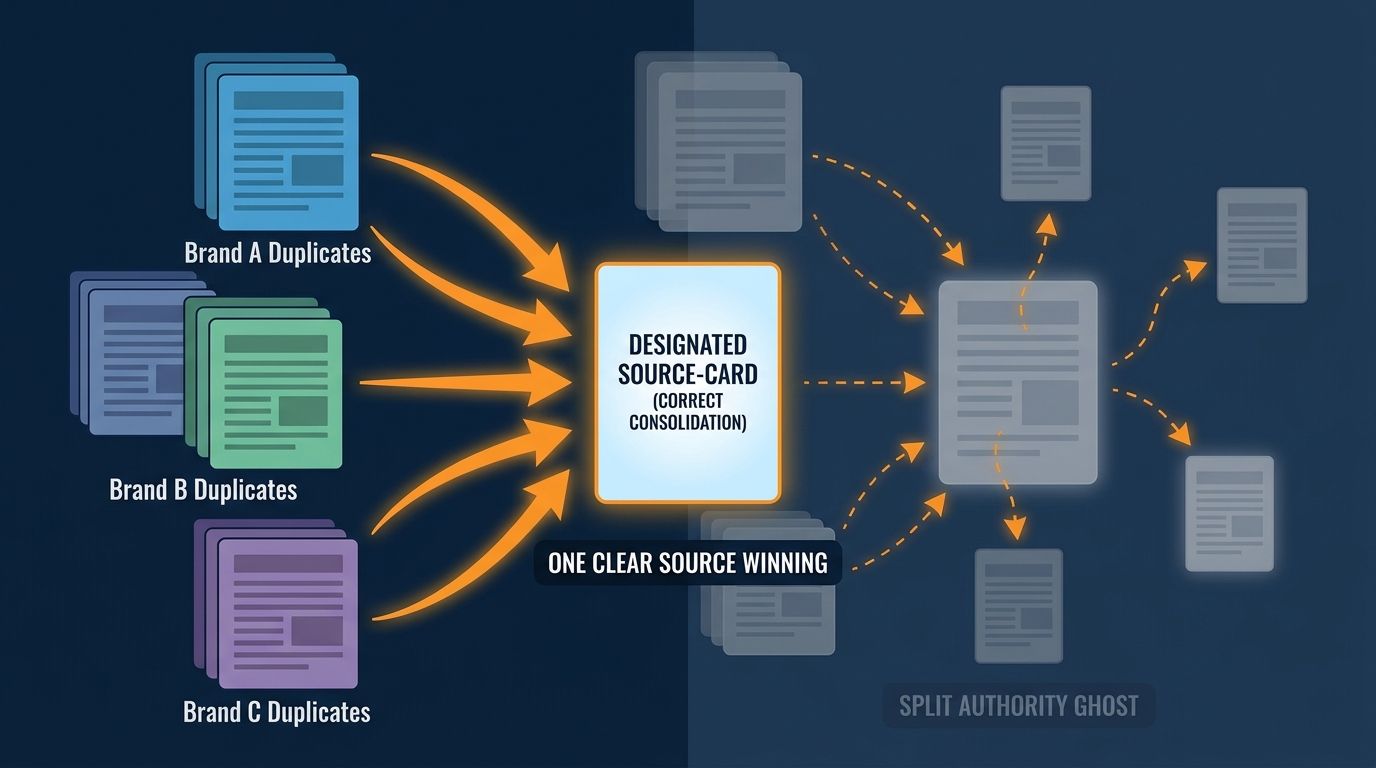
In multi-brand and multi-site setups, canonical tags decide which version of duplicated content earns the citation, and misconfigured canonicals quietly kill it. When the same content lives on several brands or domains, a wrong or missing canonical either splits authority across duplicates so none is strong enough to cite, or points it at the wrong page entirely. The fix is deliberate canonicalization: decide which URL should be the authoritative source for each piece of content and make every duplicate point to it, consistently, in a way that matches your actual entity structure. Canonical tags are not a housekeeping detail here. They are the instruction that tells an engine where your authority lives.
Canonical tags are treated as routine duplicate-content housekeeping, and in single-site setups they mostly are. In multi-brand and multi-site operations, they become a decision about where citation authority concentrates, and getting them wrong is one of the quieter ways to lose citations you should be winning. When the same or similar content exists across several brands or domains, the canonical tag is how you tell an engine which version is the source, and a mistake here splits or misdirects the authority that citation depends on.
The stakes are specific to duplication at scale: the more places your content lives, the more the canonical decision determines whether your authority concentrates on one citable page or scatters across many weak ones.
What canonicals do for citation
A canonical tag names the authoritative version of a page when duplicates or near-duplicates exist. For engines, that consolidation matters because duplicate content splits signal: if the same content sits on five URLs with no clear canonical, the authority that could make one page citable is divided across five, and none is clearly the source. The canonical tag concentrates that authority on the version you designate, which is the same concentration logic as the citation-pull in internal linking, applied across duplication. Consolidated authority is citable; split authority often is not.
The multi-brand failure modes
Multi-brand setups create canonical mistakes that single sites do not. Split authority: the same content published across brand sites with each canonicalizing to itself, so the authority divides and no version is strong enough to be selected. Misdirected canonical: a page canonicalizing to the wrong URL, sending authority to a page you did not intend to be the source, sometimes another brand's. Missing canonical: near-duplicate content with no canonical at all, leaving the engine to guess which version is authoritative, which it often does inconsistently. And cross-brand confusion: canonicals that contradict your actual entity structure, telling the engine a relationship between brands that is not the one you operate, which feeds the kind of entity confusion that leaks citations.
Deciding the canonical structure
Fixing this starts with a decision, not a tag: for each piece of duplicated content, which URL should be the authoritative source. That decision should follow your real strategy, if one brand is the flagship for a topic, its version is canonical; if content genuinely belongs to one brand and is syndicated to others, the origin is canonical. Then implement it consistently: every duplicate points to the chosen source, and the canonicals agree across all the places the content lives. The structure should reflect how your brands actually relate, because canonicals that contradict your real entity structure confuse the engine about who you are, not just which page to cite.
Canonical and entity have to agree
The subtle multi-brand requirement is that your canonical structure and your entity signals tell the same story. If your canonicals say brand A is the source but your entity signals present the brands as unrelated, the engine gets contradictory instructions and resolves them unpredictably. Align them: the canonical structure, the entity relationships, and the cross-source identity signals should all describe the same brand architecture. When they agree, the engine consolidates authority as you intend; when they conflict, it consolidates unpredictably or not at all.
How to audit it
Map your duplicated content across brands and check each cluster: is there a clear canonical, does it point to the intended source, do all duplicates agree, and does the structure match your entity architecture. Watch for self-canonicalizing duplicates that should defer to a source, canonicals pointing at redirects or dead pages, and cross-brand canonicals that contradict your real relationships. This is worth checking during any migration or rebrand, when canonical structures are most likely to break silently, and it pairs with the monthly citation audit as a periodic check.
Canonical tags feel like a technical housekeeping detail, and in a multi-brand operation they are a strategic instruction about where your authority lives, quietly deciding which of your own pages wins the citation and which of your own pages it loses to. The organizations that scatter content across brands without a deliberate canonical structure are competing against themselves in the engine's index, splitting an authority that, consolidated, would be citable. The fix costs nothing but attention, and the failure costs citations you never see yourself lose, because they go to a duplicate you also own.
Sources
- Google Search Central, consolidate duplicate URLs: the official guidance on canonicalization. developers.google.com
- Google Search Central, canonical link element: how the rel=canonical signal is interpreted. developers.google.com
- Website AI Score, information gain: why duplicate content splits the signal citation needs. View article
- Website AI Score, the entity home: why canonical structure must match brand architecture. View article
- Website AI Score, adversarial AEO: how contradictory signals feed entity confusion. View article