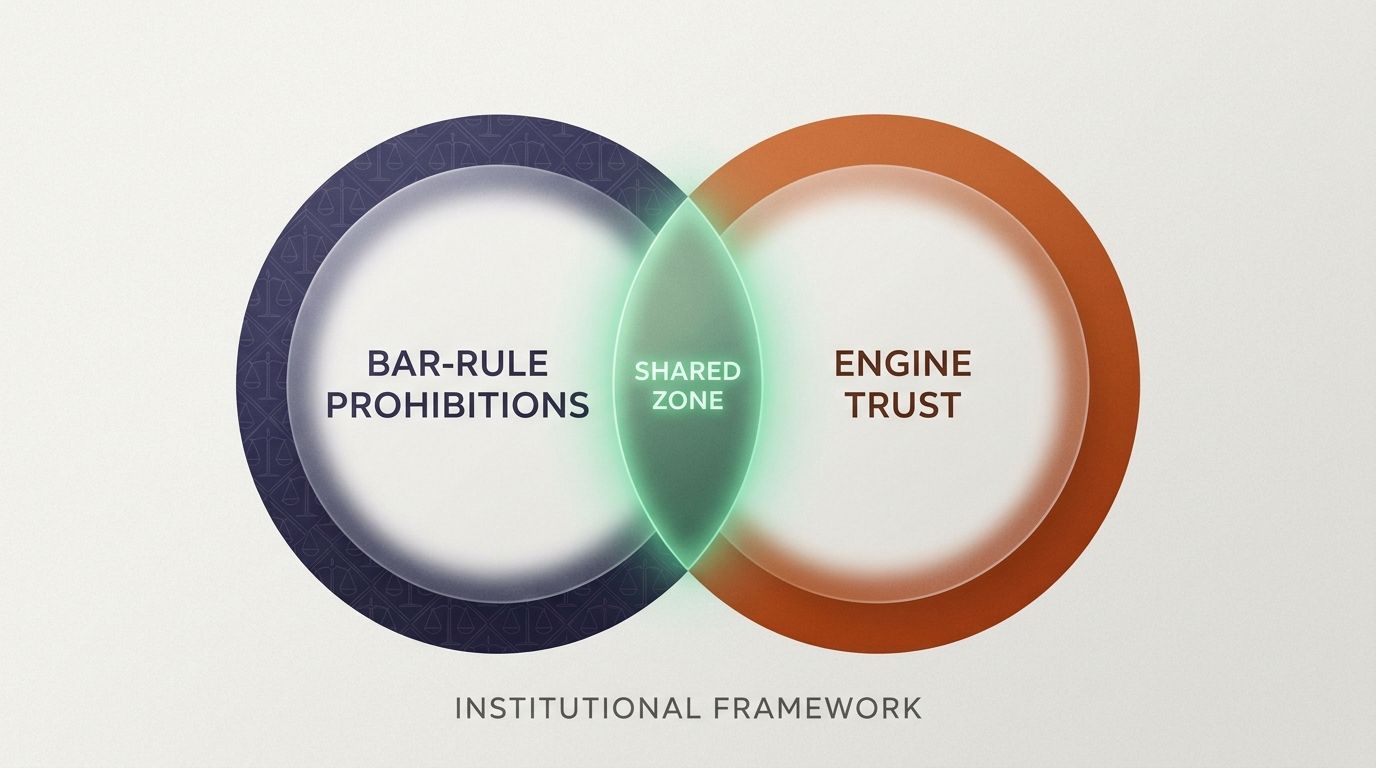
Law firms can earn strong AI citations without violating attorney advertising rules, because the two goals pull in the same direction. Bar rules prohibit false or misleading claims, unsubstantiated superlatives, and guarantees of outcome. AI engines independently distrust exactly those signals and reward the opposite: verifiable credentials, cited authority, precise scope, and honest limitation. The move is to build what this article calls a compliant authority surface: content whose citability comes from provable expertise and clear jurisdiction, not from persuasion. Stop trying to sound impressive. Start being verifiable. The firms that win legal AI citations are the ones a regulator would also approve.
Legal marketing operates under constraints most industries never face: state bar rules on advertising and solicitation, prohibitions on misleading claims, restrictions on how results and specializations can be described, and disclaimer requirements. Practitioners often treat these as a tax on visibility. For AI citations, they are closer to a specification. The reason is that engines applying heightened scrutiny to high-stakes topics, legal information affects people's rights and money, reward the same restraint the bar demands.
This article is about earning citations inside the rules, not around them. Every tactic here is one a compliance officer would sign off on, because the thesis is that in regulated verticals, compliance and citability converge rather than conflict. Where they appear to conflict, the marketing instinct is usually the thing that is wrong, not the rule.
Why bar rules and engine trust align
Attorney advertising rules broadly prohibit false or misleading communications, unverifiable claims of superiority, and language that creates unjustified expectations. AI engines, when handling legal queries, down-weight sources exhibiting exactly those properties, because unsubstantiated superlatives and outcome guarantees are signals of low trustworthiness in precisely the content categories where trust matters most. A page claiming "the best personal injury lawyer, guaranteed results" violates the bar and reads to an engine as promotional noise. A page stating "personal injury practice, licensed in Ohio since 2009, focus on premises liability, past results depend on specific facts" satisfies the bar and gives an engine verifiable, citable substance. The rule and the algorithm want the same page.
Build the compliant authority surface
The compliant authority surface is the set of signals that establish provable expertise without crossing into prohibited claims. Four components carry it. Credentials, stated precisely: jurisdictions of licensure, year admitted, verifiable bar standing, and genuine areas of concentration described in the language the rules permit (many jurisdictions restrict the word "specialist" or "expert" without certification, so mirror your jurisdiction's exact allowed phrasing). Authored substance: articles and explanations written by named attorneys with real credentials, which is the legal version of a proper entity home anchoring who you are. Citation to primary law: linking to statutes, rules, and cases grounds your content in verifiable authority, which is both good legal writing and exactly what engines reward. And honest scope: stating clearly what you do, where, and for whom, which reads as trustworthy precision rather than the everything-for-everyone vagueness engines discount.
Structure legal answers for extraction
Legal questions asked of AI engines tend to be specific and jurisdiction-bound: "statute of limitations for breach of contract in Texas," "is a handwritten will valid in Florida." Content that earns the citation answers the exact question directly, states the jurisdiction explicitly, and qualifies honestly, then the engine can lift a clean, correct passage. Leading with the answer in the first hundred tokens matters more here than almost anywhere, because a legal answer buried under throat-clearing loses the citation to a source that states the rule plainly, and a legal answer without its jurisdiction is worse than useless, so engines rightly distrust it.
The disclaimer question comes up constantly: does required "this is not legal advice" language hurt citability? It does not, when placed correctly. A disclaimer at the end of substantive, correct content is a trust signal. A disclaimer substituting for substance is not. The failure mode is pages that are all disclaimer and no answer; those deserve to lose the citation.
The entity layer for firms and attorneys
Engines cite people as well as pages, and in law the individual attorney is often the stronger entity. Establish each practicing attorney as a verifiable entity: consistent name and credentials across the firm site, bar association profiles, legal directories, and authored content, all agreeing. This corroboration is what lets an engine confidently attribute expertise, and it is the legal-vertical application of anchoring an entity across sources with sameAs. A firm whose attorneys are strong, consistent entities earns citations a firm with anonymous "our team" pages never will, and the strong-entity version is also the version that survives structured-data scrutiny.
What not to do
Do not manufacture reviews or testimonials, prohibited in many jurisdictions and a trust risk with engines that increasingly detect inauthentic signals. Do not use comparative superlatives your jurisdiction restricts. Do not publish jurisdiction-free legal content to widen reach, an answer that does not state which law it describes is both a compliance exposure and a citability failure, since engines handling legal queries need the jurisdiction to trust the passage. And do not let marketing rewrite substantive legal content into promotional language; the rewrite usually removes the exact specificity that made it citable.
The firms most frustrated by bar advertising rules are usually the ones whose marketing was built on the claims the rules prohibit, and those same claims are what engines discount anyway. The constraint they resent is quietly protecting them from producing content that would not get cited regardless. In legal AEO, the compliance department and the citation algorithm are, unusually, on the same side, and the firms that internalize that stop treating the rules as an obstacle and start treating them as the brief.
Sources
- ABA Model Rules of Professional Conduct, Rules 7.1 to 7.5: the framework for attorney communications and advertising. americanbar.org
- Google, creating helpful, reliable, people-first content: the trust and expertise signals engines reward, sharpest in high-stakes topics. developers.google.com
- Schema.org, Attorney and LegalService: the structured-data types for legal entities. schema.org/Attorney
- Website AI Score, the entity home: anchoring firm and attorney identity for citation. View article
- Website AI Score, eight schema properties that move citations: the structured-data layer for professional services. View article