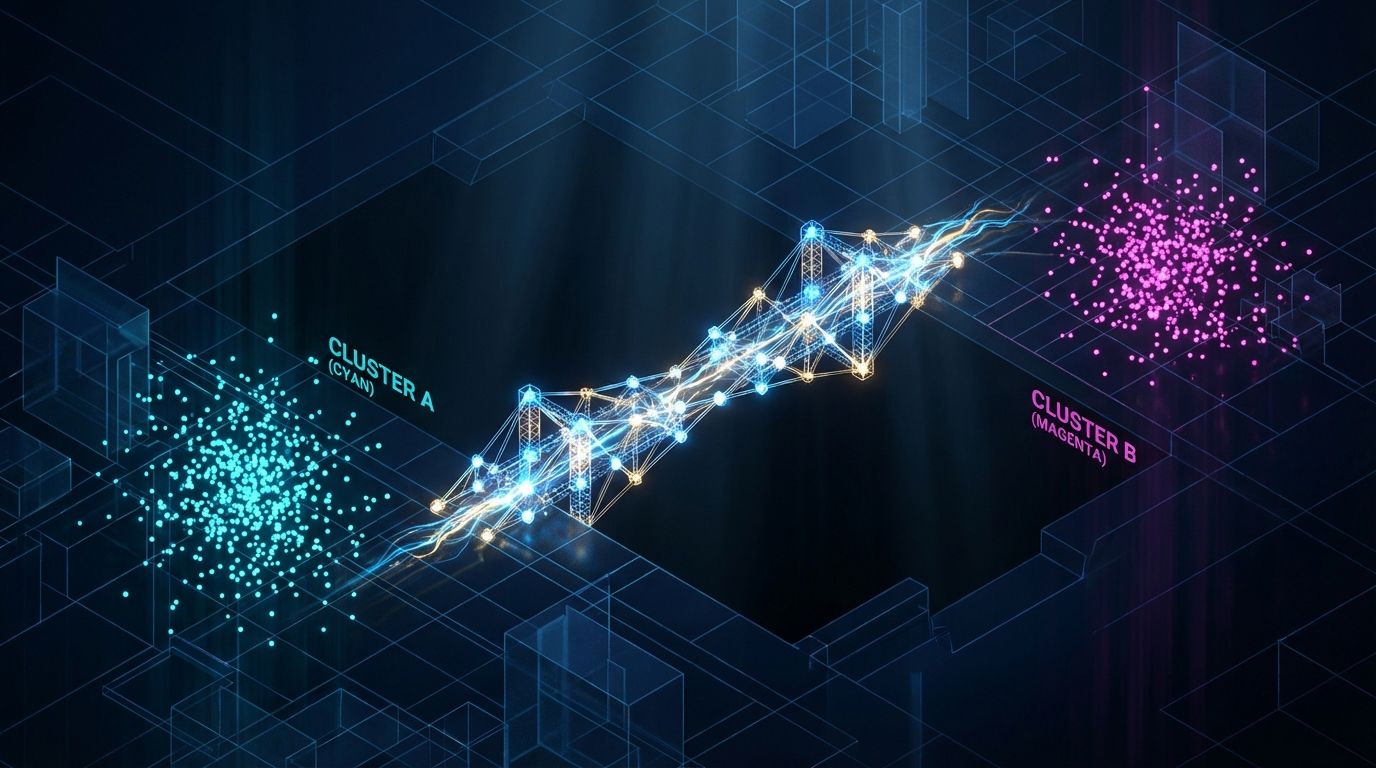
A Contextual Bridge Page is not a content-marketing asset, it's a topological repair mechanism for orthogonality failures in high-dimensional vector space. When a query requires multi-hop reasoning between two semantically distant concepts (A and D), their cosine similarity approaches zero and the engine perceives them as unrelated, a Semantic Gap. A bridge page acts as an intermediate vector node carrying the connective tissue (concepts B and C) needed to bisect the angle between the clusters, converting a zero-shot inference failure into a guided traversal across the knowledge graph and preventing hallucination by surfacing causal chains rather than keyword-proximate noise.
1. The Latency vs Accuracy Trade-off
The prevailing dogma relies on "better embeddings" (larger models) and massive hierarchical vector indexes (HNSW), on the assumption that higher dimensional fidelity automatically captures complex relationships. That fails at scale because of the geometry of meaning. Standard embeddings use cosine similarity, which measures vector orientation, not magnitude or transport cost, and that creates three blind spots: scale invariance (cosine normalizes away magnitude, treating a 500-page treatise and a 5-word summary as identical if their angle aligns), syntactic blindness (aggregated pooling misses inversions like "not" that reverse meaning without moving the vector's quadrant), and the multi-hop gap (if Concept A, genetic mutation, and Concept D, physiological symptom, share no lexical overlap, they sit on independent planes, so the pipeline retrieves A and D but misses the causal link and the LLM hallucinates the relationship). The pivot: stop optimizing the embedding model and start optimizing the vector topology, explicitly engineering bridge pages and using pruned proximity graphs to force the routing pathways between orthogonal clusters. This is the constructive inverse of the Vector Exclusion Zone: there you stay far from competitors, here you build a deliberate path between your own distant nodes.
2. Quantifying Semantic Distance in High Dimensions
To engineer a fix you must quantify the failure. Cosine similarity is the dot product of two vectors divided by the product of their magnitudes: as the score approaches 1 they point the same direction (synonyms), and as it approaches 0 they're perpendicular (orthogonal, no relationship to the engine). Word Mover's Distance (WMD), derived from the Earth Mover's Distance, reveals the true cost of transporting meaning from A to B by measuring the minimum cumulative distance individual words must travel to match the target, but it's too slow for real-time search. We need WMD's accuracy at cosine's speed.
Contrary to the belief that HNSW's speed comes from its hierarchy, the Hub Highway Hypothesis holds that high-dimensional graphs naturally form "hub nodes" appearing in the nearest-neighbor sets of disproportionately many other vectors. Standard HNSW uses memory-heavy layers to route traffic; FlatNav, a single-layer aggressively pruned graph, preserves only the edges connecting to hub nodes. By identifying the hubs you strip away HNSW's hierarchical overhead without losing recall, provided you inject bridge pages to connect isolated islands of data onto those hub highways. The chunking discipline beneath this is covered in sliding window chunking. The snippet below identifies where a bridge is required by measuring the distance between sequential logical steps.
3. Active Retrieval and Loop Budget Optimization
The primary failure mode in enterprise RAG is context dilution during multi-hop reasoning, and the usual answer, "larger context windows," is wrong, for the reasons laid out in the needle-in-a-haystack audit. The insight: the marginal utility of a bridge page is highest when using Active Retrieval Loops with a loop budget of 1. When a retrieval controller detects a distractor (irrelevant document), a single corrective loop swapping the distractor for a targeted bridge page raises Judge-EM accuracy by roughly 35%. Success doesn't require infinite retries, it requires a topology that lets the system find the bridge immediately. You can also bypass manual creation with HyDE (Hypothetical Document Embeddings): forcing an LLM to hallucinate a "fake" answer creates a synthetic bridge page whose vector, structurally rich and semantically dense, sits geometrically closer to the target truth than the user's raw query, bridging the gap between query vector and document vector.
4. Engineering the Synthetic Bridge
Phase 1, topological mapping: embed the corpus with Sentence-BERT or equivalent, apply UMAP to project vectors into 2D/3D, use HDBSCAN or Leiden to find dense clusters, then run gap analysis to identify clusters at high semantic distance that should be logically connected ("Symptoms" vs "Treatments"). Phase 2, dynamic boundary chunking: stop using fixed 500-token chunks, implement semantic chunking by calculating cosine similarity between adjacent sentences and splitting only when the distance exceeds a coherence threshold, so each vector represents a cohesive atomic concept rather than a fragmented thought. Phase 3, bridge injection: either static (Graph-RAG relational nodes, storing the edge metadata between Concept A and Concept B as a permanent text vector) or dynamic (HyDE: user query in, LLM generates a hypothetical answer, embed that synthetic bridge, search, retrieve real evidence). Phase 4, active retrieval: implement a controller agent with loop budget = 1, triggering on high context-similarity variance (noise) to discard outliers, then re-query using the centroid of the valid context to find the missing intermediate node. The distinctness of each node, so bridges don't collapse into collisions, is governed by embedding collision control.
Are there gaps in your knowledge topology?
Free audit. Maps the semantic distance between your key concepts and flags the orthogonal gaps where an AI agent will hallucinate the connection instead of retrieving it.
Map your topology →The contrarian point that reframes the bridge page from a hack into a strategy: the gaps in your content are more valuable than the content itself, because they're where your competitors' models are quietly inventing the answer. Everyone races to publish the A pages and the D pages, the symptom guides and the treatment guides, and almost nobody publishes the causal bridge that connects them, so when a user asks the multi-hop question the model fills the void with a confident fabrication. Owning the bridge means owning the one node every multi-hop answer in your domain has to route through, which is a far stronger position than owning yet another endpoint everyone already covers.
5. Reference Sources
- Malkov & Yashunin. Efficient and Robust Approximate Nearest Neighbor Search using HNSW Graphs. arXiv:1603.09320
- Kusner, et al. From Word Embeddings to Document Distances (WMD). PMLR v37
- Gao, et al. HyDE: Precise Zero-Shot Dense Retrieval without Relevance Labels. arXiv:2212.10496
- McInnes, et al. UMAP: Uniform Manifold Approximation and Projection. arXiv:1802.03426